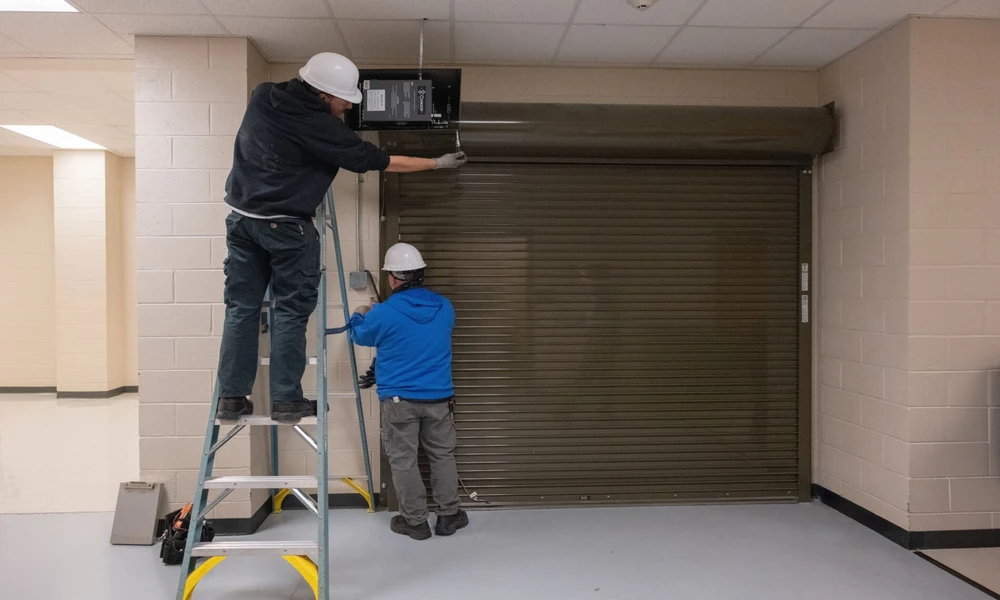
Commercial doors and dock equipment rarely fail all at once. A rolling steel fire door that refuses to close during its drop test usually got there over years of small neglect. A governor nobody greased, a chain that stretched a little each season, a bracket someone bolted to the curtain. Dock plates follow the same path, with a bent curb or a worn locking leg that never made it into a log.
The cheapest fix is almost always the earliest one. That turns door care into a ladder rather than a single decision. Each rung costs more than the one below it, catches problems the lower rung misses, and becomes necessary once the rung beneath it stops being enough. Managers who know which rung they are standing on spend less, pass inspections, and avoid the morning when a loaded trailer sits at a door stuck halfway open.
Compliance adds a second layer of pressure. Fire-rated openings fall under fire door standards, and dock plates fall under federal workplace safety rules. Neither cares how busy the shipping week was. Both expect proof that inspections happened, and both treat a missing record almost as seriously as a broken part.
For facilities across West Tennessee, Mississippi and Arkansas, A-1 Door Co. covers several rungs of this ladder from its shop in Munford, TN. Its Preventative Maintenance visits keep commercial doors balanced, lubricated and adjusted before wear turns into downtime, and its Annual Fire Door Testing handles the yearly inspection and paperwork that rated openings require. The team also installs and services Commercial Dock Plates, so the loading area gets checked alongside the doors that feed it. If your last door inspection is hard to pin down, booking one now is the simplest way to find out where you stand.
Rung One: Routine Inspection and Lubrication
This is the step in-house staff can handle weekly or monthly with a flashlight, a rag and the right lubricant. It costs almost nothing beyond time.
What it catches:
- Dry rollers, hinges and bearings that grind or squeal during travel
- Loose bolts on tracks, brackets and wall angles
- Frayed lift cables and damaged bottom seals
- Pallets, carts or stored stock parked in a fire door’s closing path
- Dock plates with cracked welds, bent curbs or missing handholds
Skip it and friction builds quietly. Openers work harder, motors run hot, and a blocked fire door will fail its annual test no matter how well the hardware performs.
Move up when lubrication no longer stops the noise, the door travels unevenly, or the same issue keeps coming back after a week.
Rung Two: Scheduled Preventative Maintenance
Here a trained technician visits on a set schedule, usually quarterly or twice a year depending on how many cycles each door runs. Busy dock doors earn shorter intervals.
What it catches:
- Spring tension drift that throws the door out of balance
- Worn cables, drums and sheaves before they snap
- Opener force settings and reversing functions that have slipped
- Track misalignment from forklift bumps
- Chain and drive wear on rolling doors
Skipping it shows up as broken springs and snapped cables, usually at the worst possible hour. Standard torsion springs are often rated around 10,000 cycles, and a high-traffic dock door can burn through that in a couple of years without anyone counting.
Move up as soon as the building has fire-rated openings. Maintenance keeps doors running, but it does not satisfy the annual testing requirement.
Rung Three: Annual Fire Door Testing and Documentation
NFPA 80, the Standard for Fire Doors and Other Opening Protectives, calls for fire door assemblies to be inspected and tested at least once a year, with a signed written record kept on hand for the local fire authority. For rolling steel fire doors, the 2022 edition tightened who can do the work. The door industry’s trade association explains in itstechnical data sheet on rolling steel fire door inspection that these doors must now be tested by a trained rolling steel fire door systems technician, and that periodic testing remains the building owner’s responsibility.
What it catches:
- Release devices and fusible links that no longer trigger closing
- Doors that stall, close too fast or stop short during the drop test
- Hardware, signs or conduit attached to the door that is not part of the listed assembly
- Painted-over or missing labels that make the rating impossible to verify
- Field paint on guides and curtains, which counts as maintenance and needs checking
Deficiencies found during the visual check get corrected before the drop test runs. Skip this rung and the risks stack up: citations from the fire marshal, awkward questions from an insurer after a loss, and a door that may not close when smoke is actually in the building.
Move up when testing turns up a failed component that adjustment alone cannot fix.
Rung Four: Component Repair
Repairs replace parts rather than tune them. On doors that means springs, cables, rollers, damaged sections, bent tracks and worn operators. On dock plates it means curbs, legs and handles.
Dock plates carry their own rulebook. Under OSHA’s dockboard standard, 29 CFR 1910.26, they must support the maximum intended load, portable plates must be secured so they cannot shift, and trailers must be held in place with wheel chocks or similar measures while workers are on the plate. Plates put into service on or after January 17, 2017 also need run-off protection along the edges.
Common repairs at this stage:
- Matched spring replacement with balance reset
- Track straightening or replacement after impact
- Section replacement on dented panels
- Curb and weld repair on dock plates
- Fire door parts swapped only for components that keep the listing intact
Skipping repairs usually means temporary fixes that hold until they do not. A door propped with a jack stand or a plate with a cracked curb is a reportable hazard, not a workaround.
Move up when repair bills start recurring on the same opening, parts are discontinued, or the door keeps taking hits it was never built for.
Rung Five: Full Replacement
Replacement is the most involved step, and sometimes the cheapest one over five years. It makes sense when an opening keeps costing money without getting more reliable.
Signs it is time:
- Repeated impact damage on a door that sees more traffic than its design rating
- Obsolete operators or springs with no available parts
- A fire door that cannot be restored to its listed condition
- Older dock plates without run-off curbs in spots where equipment could roll off
- Changes in use, such as a storage door now cycling dozens of times per shift
Putting off replacement tends to mean paying for repairs on a door that is already finished. The money spent patching it often covers a good share of a new unit.
The ladder works best when it is climbed on purpose. Facilities that keep the bottom two rungs steady rarely reach the top one by surprise, and their annual fire door test becomes a formality rather than a scramble. A short log of what was checked, what was found and what was fixed is the thread that ties every rung together, and it is the first thing any inspector will ask to see.